Throw A Blind Wine Tasting Party: Easy and Ridiculously Fun!
My complete guide with checklists and tips to help you plan a blind wine tasting party that’s crazy fun, memorable, and easy to host.
If the phrase “subtle notes of gooseberry and graphite” makes you roll your eyes a little — or a lot — you’re not alone.
Wine is great, but the snobbery that sometimes swirls around it? Not so much.
That’s why a blind wine tasting party is one of my favorite ways to bring people together for a good laugh, a little friendly competition, and maybe even discover a new go-to bottle.
And to make it even more fun (and a whole lot less intimidating), I created some pop culture-inspired scorecards that turn serious wine attributes into hilariously relatable judging scales. Think “Bernie Madoff’s balance sheets” vs. “2+2 = 4” for clarity.
🍷 Curious? Read on for everything you need to host your own no-pressure, high-fun blind wine tasting party — complete with a free planning checklist and $5 downloadable scorecards that’ll have your guests laughing and chatting all evening long!
TABLE OF CONTENTS
The links in this post may include affiliate links, which means if you purchase anything using these links, you pay no extra, but I may receive a small commission that helps keep this blog running. I truly appreciate you using affiliate links whenever possible. Please know that I will never recommend a product I do not believe in!
What Even Is a Blind Wine Tasting
(and Why It’s the Best Kind)?
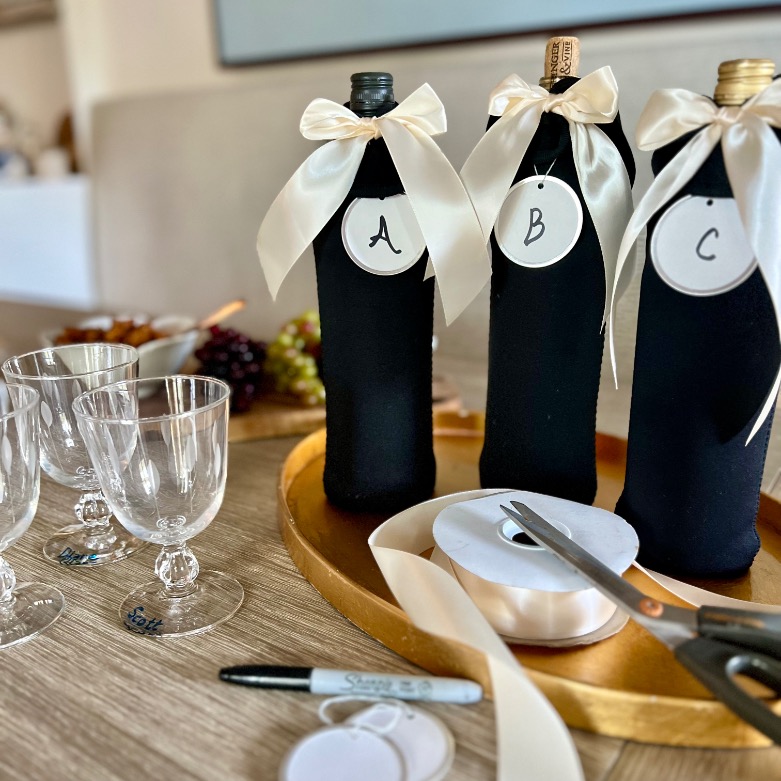
Sometimes called a mystery wine tasting, this party is exactly what it sounds like — a wine tasting where no one knows which bottle they’re drinking. No labels. No price tags. Just wine in a glass and your very own taste buds calling the shots.
It’s the perfect way to:
- Take the pressure off (no one has to pretend they “get” hints of leather and forest floor)
- Level the playing field (Trader Joe’s bottles welcome!)
- Add a little intrigue and mystery
- Surprise yourself with what you actually like
Whether you’re a full-on vino nerd or just here for the cheese tray, blind tastings keep it relaxed, social, and surprisingly insightful.
What You Need to Host a Blind Tasting at Home
The setup is super simple. Here’s what you’ll need:
- Bottles of wine — well, duh!
- Bottle disguises. From brown paper bags to those cute numbered bottle sleeves, the key is to keep it all mysterious. Keep scrolling for more on the bagging options
- Fun Score cards and pens or boring score cards, or if you must, even more boring notepads will do
- At least two corkscrews
- Wine glasses (one per guest, if you rinse between pours OR number of guests x number of pours)
- A way to ID the glasses
- Water and palate cleansers (crackers, apple slices, etc.) for between tastings
- Pitcher of water and a bowl (explained in step 3)
- More substantial snacks and nibbles, and perhaps coffee for after the official tastings
- Prizes if you choose to set yours up to be a competitive wine tasting
- A great playlist, because what’s a party without a playlist. And to keep things simple, I made a playlist my subscribers can find in the Free Resource Library.
- And hey — to make your life easier, I whipped up a free printable party checklist to make sure you don’t forget a thing
How to Run Your Blind Wine Tasting
Here’s how to keep things fun, flavorful, and fuss-free —
1) Choose Your Wines (With a Filter, Please!)–
While anything goes might sound like fun, trust me, your tasting will be way more enjoyable if you set some kind of parameter(s) for the wines.
Otherwise, it’s apples to oranges… or cabernets to chardonnays… and nobody wins.
You can go traditional:
- All reds or all whites
- Same varietal (like all different Pinot Noirs)
- Same locale (e.g., all California wines)
- Same year
- “Best white under $12” (a personal favorite — budget-friendly with bonus surprise factor)
Make it as broad or narrow as you like.
Or go pop culture inspired:
- Screw Top Showdown — twist-offs only, zero corks allowed
- Tariff-Free Tasting — domestic wines only; let’s discover what the U.S. does best before import fees make us cry in our merlot
Cautionary Tale:
Do your research!
True story (I probably shouldn’t be admitting), in 2024 we hosted a wine tasting where everyone was to bring a bottle of white from 2014. Well, little did we know it was very difficult to find a bottle from 2014, and when you did it was outrageously priced.
Bottom line: Pick a theme that keeps things on relatively even footing — and makes the final reveal more fun (and fair).

2) Bag and Tag the Bottles (Best Tip: Use Letters!)-
Bag or wrap each bottle to keep it a mystery, and label them clearly.
You have several options for disguising the bottles:
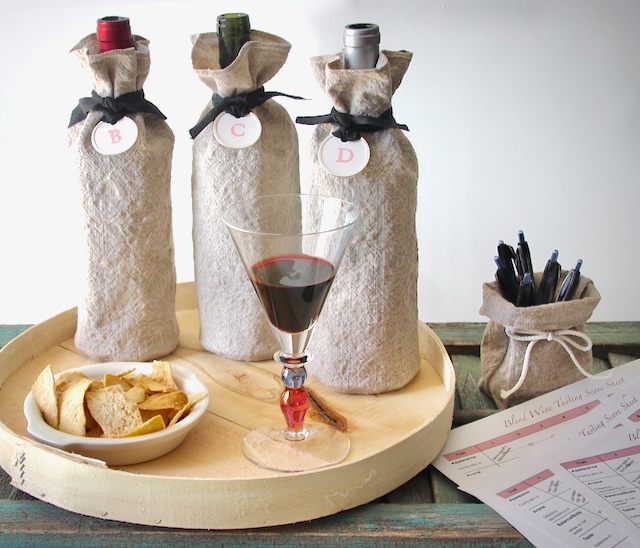
- First is a bag with a label sewn on it or tied on it.
NOTE: I no longer make and sell the bags with the chalk cloth labels or separate labels tied on that show in some of my pictures. This is a nice alternative from an Etsy maker
- Neoprene thermal bags with hanging labels for whites that are best chilled. These are the ones I show here with the hand holds folded down and tied with ribbon. Detailed how-to tie these is below.

- Tall brown paper liquor store bags tied with string, garden twine, jute, baker’s string, whatever
- Brown craft paper can be used very effectively and exude two alternative styles:
- wrapped in sleek, tailored style with ribbon and tag can be very stylish
- wrapped in rumpled brown paper with a magic marker letter and string ties or duct tape for that decidedly trash aesthetic can be fun for a screw-top wine showdown
- Wrapping bottles with foil is another easy way to go. However, I’ve never been satisfied with how they look, just saying.
Hosting Tip: Use letters instead of numbers (Wine A, Wine B, etc.)
Scoring is numerical, so best for the bottles to be alpha.
After a few tastings, too many numbers can turn into a comedy of errors:
“Wait… did I give bottle #4 a 3, or was that bottle #3 a 4?”
Letters are cleaner, clearer, and zero stress..
How Did I Tie the Thermal Wine Bags Closed?
Just a couple of easy steps turn these thermal bottle sleeves into the perfect wine bottle disguises:
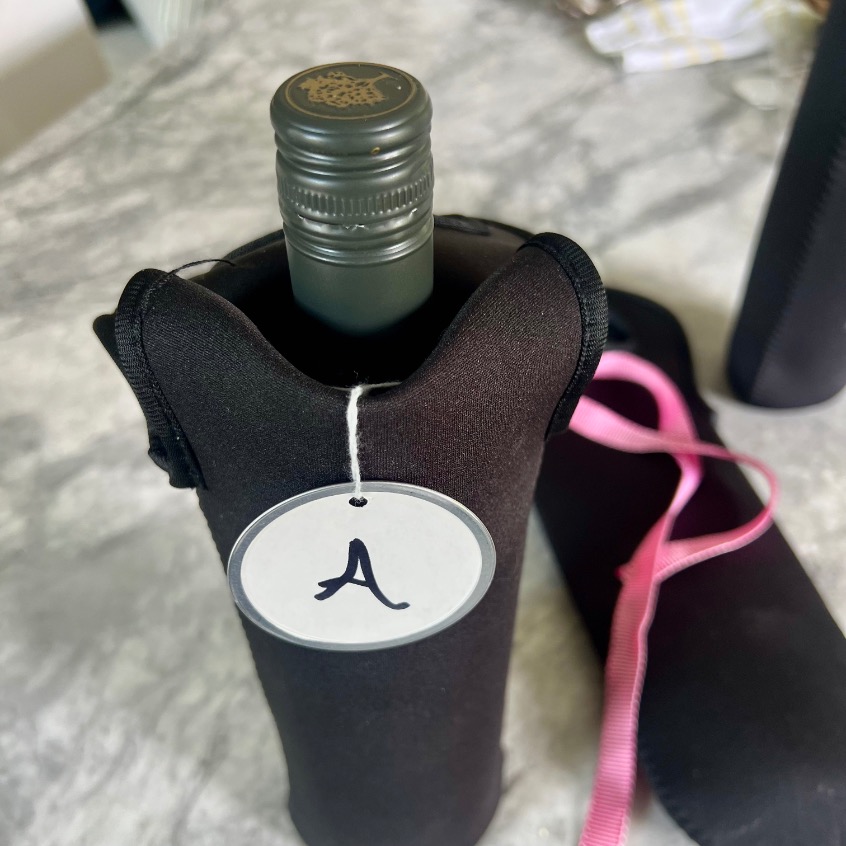
Fold the front half down inside itself, between the front of the bottle and the bag. Hang an alpha identifier tag around the neck of the bottle and over the front of the bag.
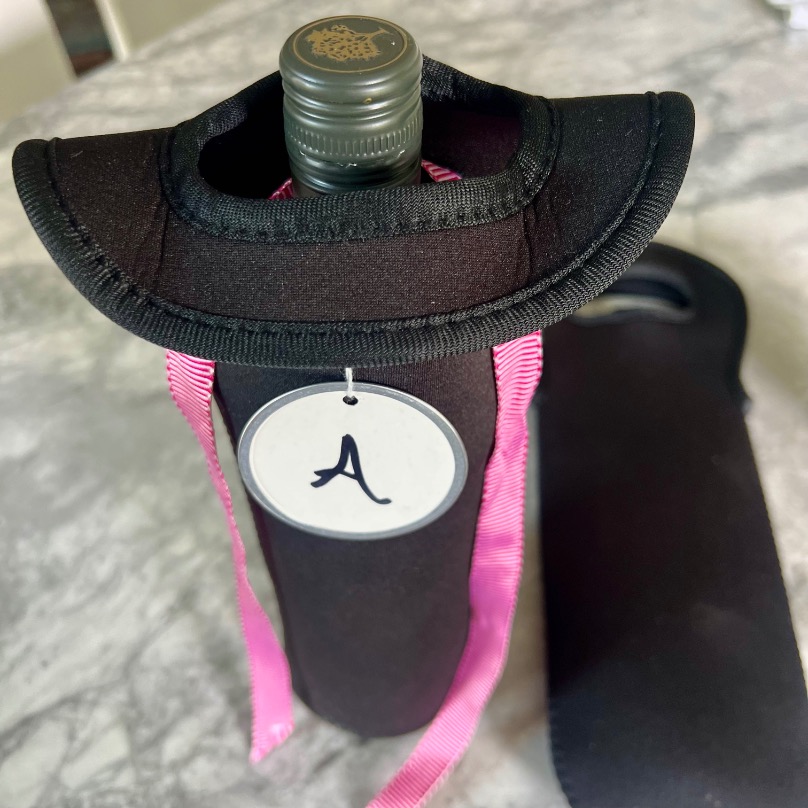
Lay a length of ribbon around the back of the bottle neck and over the front folded bag. Then fold the back half of the handle over the ribbon and bottle neck.
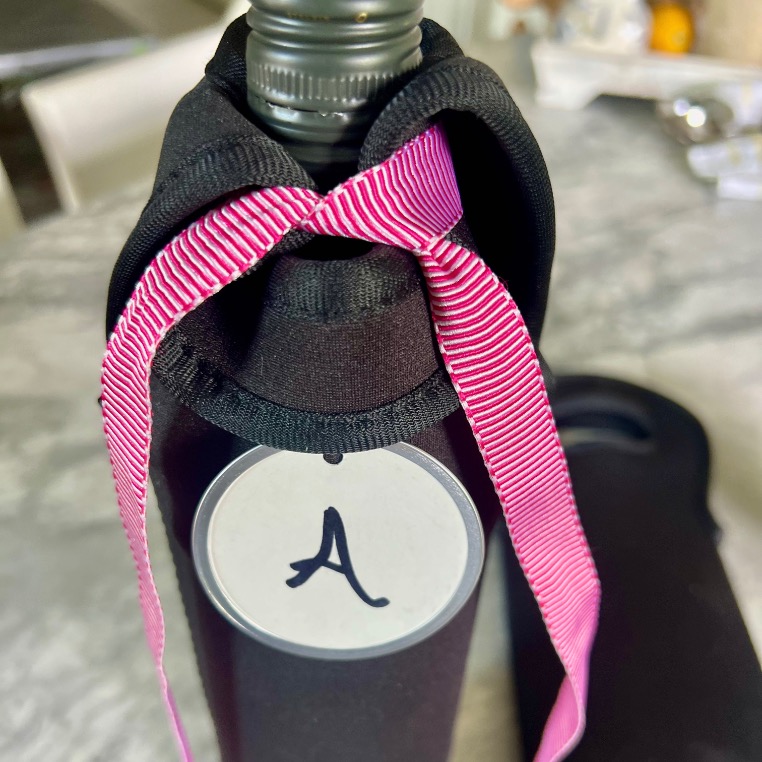
Fold the two “wings” of the back handle toward the front meeting in the middle. Pull the two ends of the ribbon tightly together crossing to make the first part of the bow to hold everything in place.
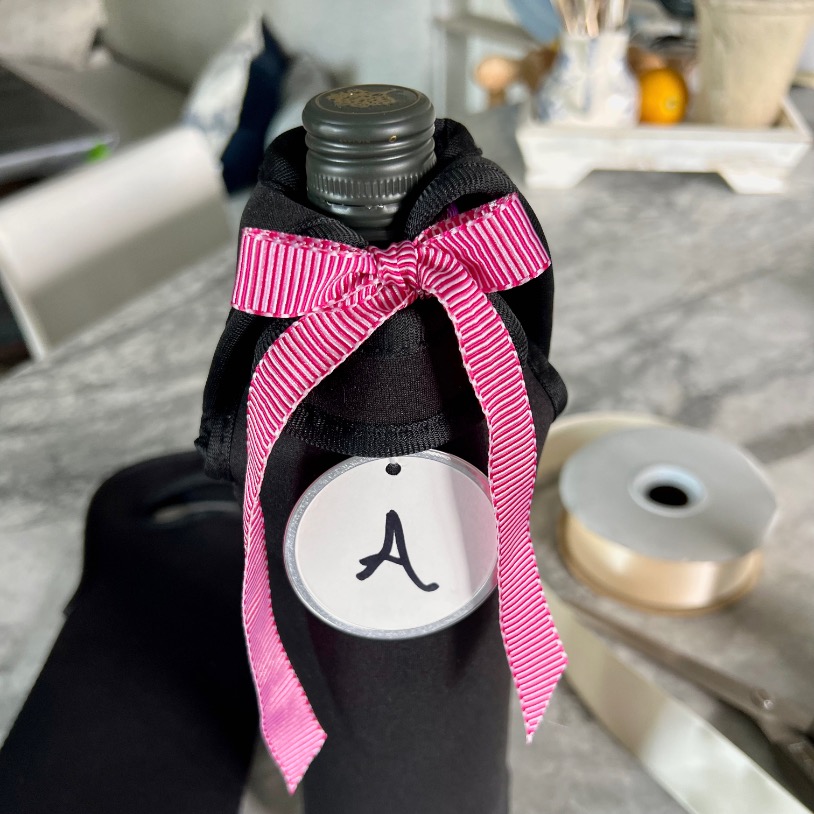
Finish the bow and trim the ends.
Looks like a cloak, right? Appropriately mysterious!

3) Pour, Taste and Score –
This is where the magic happens — and where things can either feel expertly orchestrated or like wine-fueled chaos. Let’s aim for somewhere gloriously in between, shall we?
Start by pouring the first wine and having your guests grab their glass. If you’re serving reds that need to breathe, feel free to open all the bottles at once so they can do their thing while you work your way through.
White wines should be pre-chilled and kept in the fridge or disguised in the neoprene thermal wine bottle sleeves.
Now, a note for the wine novices:
In professional tastings, it’s totally normal to not drink every single pour. Pros taste, swish, and then spit. (Yes, really.) That’s how they survive a full day of judging 40+ wines without forgetting their own name.
At your party? Totally your call.
Sip and spit, or drink, swish and dump — it’s all welcome here.
If you’re only working with one glass per person (because you didn’t rent a small vineyard’s worth of stemware), here’s how to handle it:
Between wines, guests should:
- Swirl a bit of water in the glass
- Dump it out (not on your rug, please)
- Record their score
- Move on to the next wine
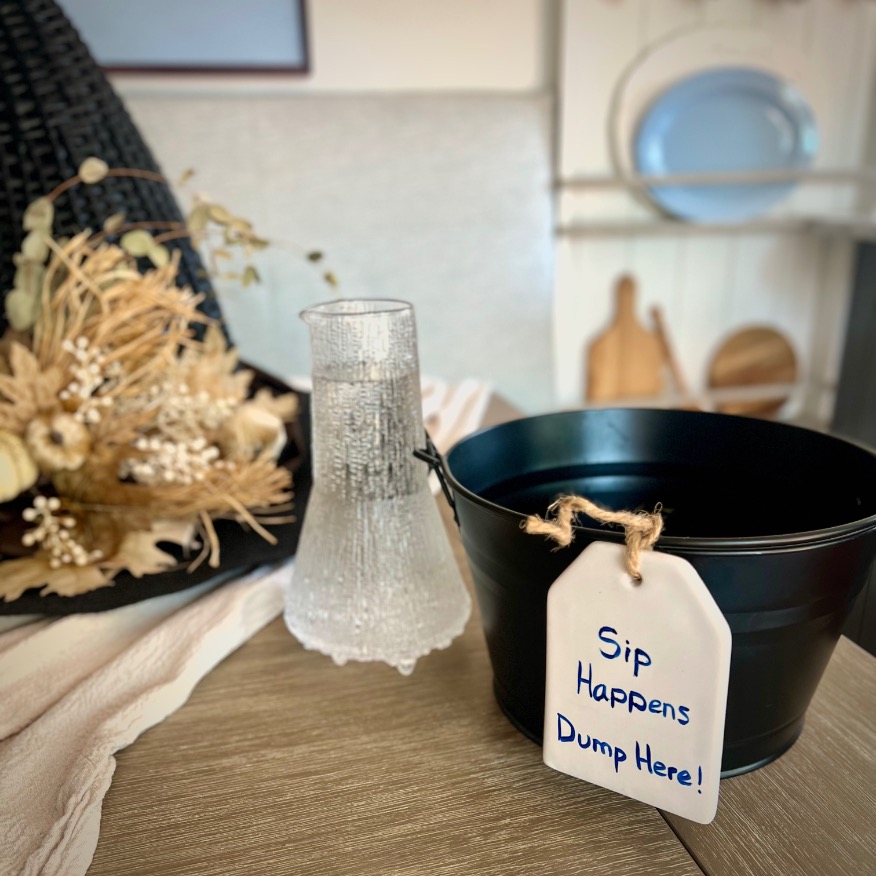
You’ll want to set up a rinse + dump station nearby. You can call it what if you want, but I prefer something a little more… party-friendly. Perhaps:
- “The Spit Spot” (Mary Poppins meets Merlot)
- “Sip Happens — Dump Here”
- “Swish & Ditch”
- “The Sacrificial Bowl of Shame”
- “Pour Decisions Recovery Zone”
Whether it’s a pitcher + mixing bowl combo, a cute enamel bucket, or your least favorite salad bowl — just make sure it’s accessible and clearly marked for wine dumping and rinsing.
Mark Those Glasses (Technically optional, but not really)

When everyone’s sipping the same wine in identical glasses, things get confusing fast!
Save yourself the glass mix-ups with a little DIY style:
- Tie different colors of ribbon or yarn around the stems
- Use wine charms, if you have them
- Or my personal favorite: write each guest’s name on their glass with an alcohol ink marker. It dries quickly, won’t smudge while sipping, and erases easily with rubbing alcohol when you’re done.
It may just be me, but I really don’t like a wine charm clinking around on my glass when I’m taking a sip.
👉 [Learn more about alcohol ink markers here]
Introducing the Pop Culture Scorecards
(Yes, They’re as Fun as They Sound)

These scorecards are the life of the party — and yes, they still use the five “proper” wine judging attributes:
- Appearance / Clarity
- Aroma
- Balance / Body
- Taste
- Finish
But instead of stiff number ratings or wine-speak, like unctuous mouthfeel, your guests will score each wine using ridiculously relatable pop culture references, like:
| Attribute | Scoring Scale |
|---|---|
| Appearance clarity akin to: | Bernie Madoff’s balance sheets → 2 + 2 = 4 |
| Balance/Body whimpy vs. full-bodied | Mini Cooper → Hummer |
| Finish As long-lasting and satisfying as: | Tamagotchi → Pac-Man |
They’re hilarious, but here’s the real magic:
These scorecards are absolute gold for sparking conversation.
Sure, they’re fun when your guests have shared history (cue the ’90s nostalgia).
But their real wizardry? They bridge the gap between new friends and soon-to-be inside-joke buddies.
Whether your group knows each other well or not at all, the scorecards open the door to stories, laughter, and surprising connections.
They’re also a dream for hosts who don’t love navigating small talk — these little cards do the heavy lifting for you.
The scorecard download is just $5 and includes:
- Four unique scorecards (Print duplicates based on your number of guests)
- Two color scheme versions (warm neutral or cool blue)
- Versions for judging 4 or 6 wines
- Instant download — print ’em, pour ’em, party on
👉 [Get the Scorecards Here – $5]
Bonus Tip: Hosting 12 guests? Print 3 copies of each card. 16 guests? 4 copies. Boom. Scalable, shareable, and still hilarious.
Make It a Competition (and Split the Cost!)
Hosting doesn’t have to mean footing the full wine tab — especially when you can turn cost-sharing into a party feature.
Ask each guest or couple to bring one bottle (or two of the same wine if you’re expecting a larger group). Give them guidelines, your theme, ahead of time — like “any red under $20” or “bring your favorite bottle of white from California, Missouri, Oregon (you pick) that you don’t mind being judged mercilessly” or “bring any domestic white from 2020, the year we moved to the neighborhood”.
The guests brings the wine, but the host bags and tags them in private.
Once bagged, reds can be brought to the serving area and opened at once. Whites can be stored in the fridge until ready for each one.
Assuming the guests brought the wines chilled, if you use thermal wine bags, you can bring white wines out at once also.
Hyper-competitive guest?
Yes, in some cases it is possible to distinguish your bottle from the rest by the bit of neck exposed at the bag’s opening.
HOST HINT: If you feel compelled to thwart the hyper-competitive guest. Funnel his/her wine into an alternate clean and dry bottle, then bag and tag this alternate bottle. Hah!
How Much Wine Do You Need?
Each standard 750ml bottle = 25 oz.
- That’s 8 3-ounce tasting pours
- Or 6 4-ounce pours, if you’re feeling generous
For larger parties:
- Have couples bring 2 bottles of the same wine
- That gives you enough for 12+ people to taste, plus a little extra to serve with snacks after judging
Prize Ideas for the Winning Bottle:
- The glory of knowing you brought the wine everyone loved
- A bottle of celebratory bubbly
- A wine charm that says “Big Sip Energy”
- A $5 trophy from the party store with a cork glued on top
- Or something a bit more “Prizey” like these below:
Frequently Asked Questions
How many wines should we taste?
Four to six is perfect. Beyond that and things get fuzzy (literally and figuratively).
Do I need to be a wine expert to host this?
Absolutely not. That’s the beauty of blind tastings — and pop culture scorecards.
Can we include boxed wine?
You’re in charge of the rules!
Perhaps pour into a washed and dried wine bottle to disguise it.
Can the scorecards be used for bigger groups?
Yes! You get 4 designs in the bundle. Just print more of each — 3 copies of each for 12 guests, 4 for 16, etc.
Can I use these scorecards again?
Totally. Purchase the file once, you own it.
Friendly reminder, the file is for your personal use, no sharing allowed and certainly no selling.
Grab the Goods
Hosting a blind wine tasting has never been this easy — or this fun.
✅ Download the free printable party checklist and prep plan
🎟️ Get the $5 pop culture scorecards
🍷 Pick your theme and assemble your dream team
🎵 Fire up the playlist (my Wine With Friends play list is waiting for you)
🎉 Pour, laugh, and crown a winner
👉 [Grab everything here and start planning]
The party checklist and prep plan and the Wine With Friends playlist are in the Free Resource Library available 24/7 for my subscribers. Not a subscriber? No worries, we can take care of that right now:
The best thing about wine tasting with friends (and even new acquaintances) is its light-hearted atmosphere.
It’s about fun, laughter and enjoying each other’s company … and a good glass of wine.